
ASGcostIQ
Empowering Airlines to Make Better Decisions. Built by Airline People for Airline People.
What does a disruption really cost your airline, and what is it worth to prevent it?
ASGcostIQ prices delays and cancellations the way they actually behave: not a flat rate per minute, but costs that step up as misconnect, crew legality and aircraft-out-of-place thresholds fire, and that depend on the fleet, hub, bank, load and connections involved. Calibrated to your own operations, customer and cost data with your finance controllers, it gives operations, planning and finance one defensible number for every decision. Bring us your disruptions and we'll show you their true costs.
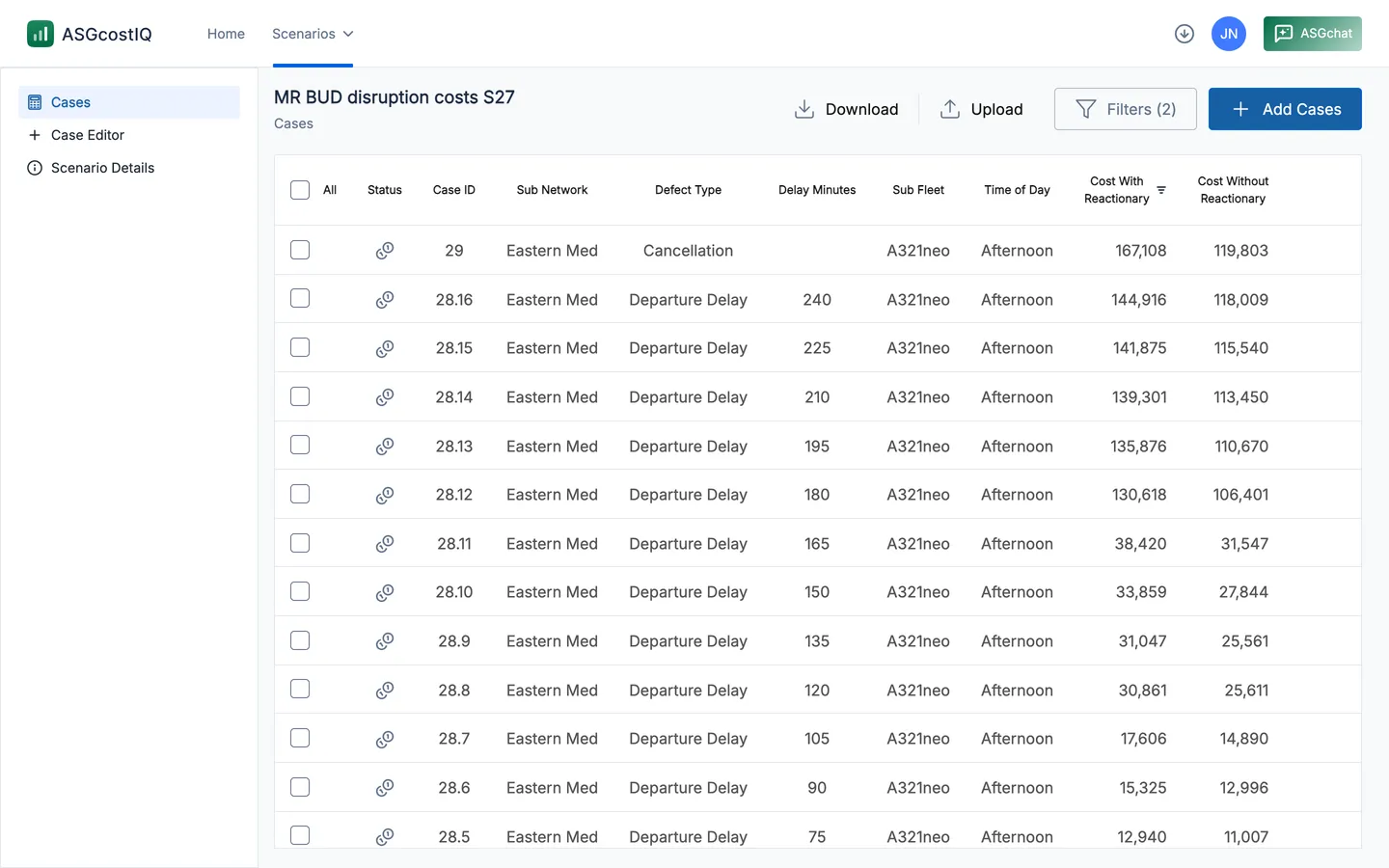
Screenshot from the application. Figures are modeled and illustrative.
What ASGcostIQ is used for
01Day-of-operations decisions
Long delay or cancel, hold for connections or depart on time, speed up or absorb the arrival delay: price each option on the flights, passengers and crew actually involved, not an average rate.
02Schedule resilience
A resilient schedule carries buffer: spare aircraft, longer turns, firebreaks at the hub. That buffer costs utilization and contribution. ASGcostIQ prices the disruptions each schedule version would incur, so the delay, cancellation and misconnect cost saved can be set against the contribution given up, and the more profitable schedule chosen, not just the more punctual one. At one carrier that was 12 points of D0 and USD 20M a year on the jet network.
03Investment returns
De-icing trucks, an aircraft swap tool, more station staff or reserve crew: each promises fewer delay minutes. ASGcostIQ converts the minutes avoided into a disruption-cost saving in finance's own terms, so the return on the investment can be compared with any other capital case.
04Targets and budgets
Cost rises when reliability is too low and when buffer is overbuilt. Set D0 and A14 goals where they pay back, and let each operating group budget against them.
Designed by airline people for airline people, ASGcostIQ focuses on what matters most:
Efficiency
Operations, planning and finance work from one shared cost basis, so a decision made in one department no longer quietly shifts cost to another.
Reliability
Every cost is calibrated to your airline: your fares, crew rules, pay scales, station costs and compensation policy, validated with your SMEs and finance controllers rather than taken from industry benchmarks.
Speed
Any disruption is priced in one run, by sub-network, fleet, hub or spoke, season, day and time of day, in the web app, in Excel or through the API.
Flexibility
Both hard and soft costs: fuel, crew, station and maintenance, misconnects and compensation, plus displacement, walkaway revenue, disservice and the reactionary ripple down the day.
Cost steps, not slopes
Delay cost is a step function: little breaks for the first 20 to 30 minutes, then misconnects, crew legality and aircraft out of place fire together, and past the cancel or swap point the ripple is cut off. ASGcostIQ models those steps from your own thresholds, so a 90-minute delay in your evening hub bank is priced as what it is.
- 01
The case
A delay or a cancellation, described by sub-network, aircraft, hub or outstation, season, day and time of day.
- 02
Your operation
Fleet and seats, and how often each delay range happens, from the Fleet and Ops Stats sheets.
- 03
Passengers
Who is on board and who connects, from Rev & Costs and Connections: misconnects, rebooking, walkaway and lost goodwill.
- 04
Aircraft and crew
Fuel, maintenance, station staff and gates, in-flight and pilot crew pay and misconnected crew, at your own rates.
- 05
Compensation
EU261 where it is due, otherwise your own policy by severity and passenger type.
- 06
Knock-on cost
The reactionary delay the disruption passes down the day, from your own delay statistics, shown as a second total.
User interface
- Web app, Excel template with add-in, or API
- Cases by sub-network, fleet, station, season, day and time of day
- Overrides for passengers, connections and fares
- Cases and results in and out as Excel
Support
Setup takes two to five weeks with ASGcostIQ advisors on site and remote: objectives are aligned with FP&A, scheduling and day-of-operations users, and the model is calibrated with your operations SMEs and finance controllers. Subscriptions include model updates and recalibration.


